
Beware of the Gushing Waters, Pakistan!
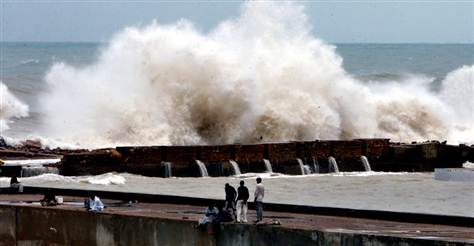
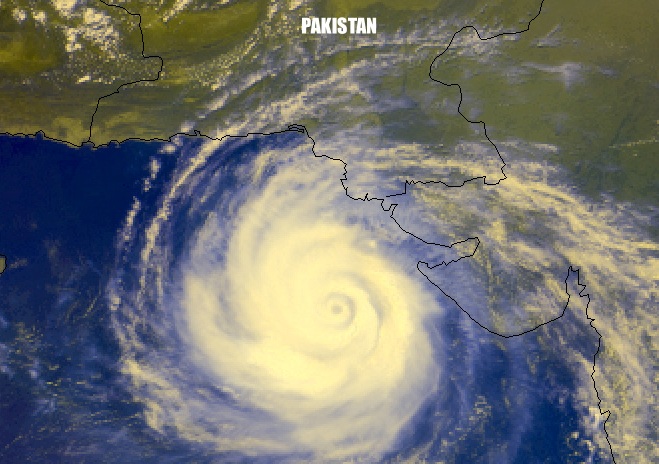
Pakistan should gear up and take necessary precautions ! because if the history is to be trusted then south Pakistan should expect a cyclone (hurricane) to affect its coastal areas during the upcoming summer. An astonishing pattern is seen in the Arabian sea as cyclones are following a ‘schedule’ to affect southern parts of Pakistan. There are five reasons to believe that a cyclone is coming this year!
Cyclones form in which month?

Cyclones in the Arabian sea (see Cyclones in Pakistan) form mostly from May till June and then from September till October, monsoon season plays a vital role for the formation of cyclone in this basin. Tropical storms that hit Pakistan are mostly remnants by the time reach Pakistan or make landfall in south eastern Sindh which is not very much populated they rarely move towards the Balochistan coast.
Each year before the onset of monsoon that is 15 April to 15 July and also after its withdrawal that is 15 September to 15 December, there is always a distinct possibility of the cyclonic storm to develop in the north Arabian Sea. There is a 98 per cent chance of cyclones to turn towards the Indian state of Gujarat, one per cent chance of moving towards the Gulf and one per cent chance of moving towards the Pakistani coast.
Top Five Reasons to believe the cyclone is coming this summer!
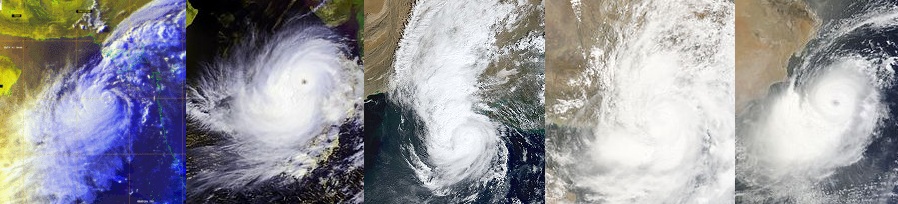
Since the 21st century, the country has seen frequent storms developing in the Arabian sea moving towards it’s coastline. Following are the reasons;
1.1998 Gujarat Cyclone – A category-3 cyclone, it killed 12 people in Karachi due to heavy rainfall. It affected Pakistan indirectly.
2. 2001 India Cyclone – The third most strongest hurricane (category-3) in the Arabian sea, had winds upto 135 miles per hour. It caused 100,000 people to be evacuated from Sindh province. It affected Pakistan indirectly.
3. 2004 Cyclone ‘Onil’ – The first cyclone to be named in the north Indian ocean. Onil brought 145 mm rainfall to Thatta, caused whole drainage system to collapse in Hyderabad while nine people died in Karachi. It affected Pakistan directly as a result 300 went missing, possibly dead.
4. 2007 Cyclone ‘Gonu’ and ‘Yemyin’ – Super Gonu (category-5) was the strongest hurricane in the Arabian sea while the second strongest in the North Indian ocean, it destroyed 200 boats in Gwadar, Gonu affected the country indirectly. Cyclone ‘Yemyin’ killed 200 people in Karachi with week long torrential rainfall, it affected the country directly.
5. 2010 Cyclone ‘Phet’ – The second strongest hurricane (category-4) in the history of the Arabian sea, it killed 15 people in Pakistan. Most damage occurred along the Makran coast. It affected the country directly.
So what is conclusion!
1998, *1999, 2000, 2001, 2002, 2003, 2004, 2005, 2006, 2007, 2008, 2009, 2010, 2011, 2012, 2013!
It is quite clear that AFTER TWO YEARS there is a cyclone in the Arabian sea that affects Pakistan either directly or indirectly! Even though there were cyclones between these years but none of them affected Pakistan with the *exception of 1999 cyclone.
2013 Pakistan Cyclone?
The above mentioned details of a coming cyclone are NOT based on a meteorological forecast but rather on an astonishing historical pattern that has caused the country to be affected by a cyclone after every two years! (we saw in 1998, 2001, 2004, 2007, 2010)
Meteorological Forecast – Things are getting hot?
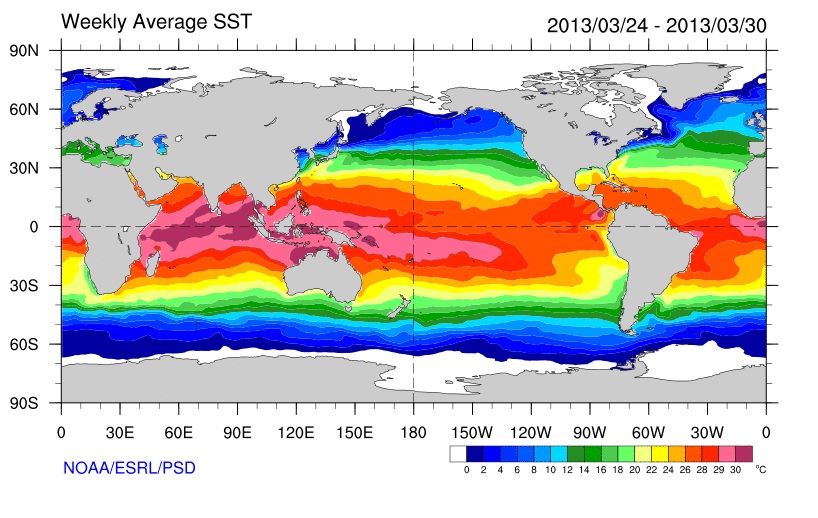
The Sea Surface Temperatures (SST) are somewhat high in the Indian ocean (both parts) as compared to other oceans. According to the map released by the U.S National Weather Service, it showed that temperatures are 29°C to 30 °C (some small pockets have above 30 °C) in the south-east Arabian sea as well as the lower Bay of Bengal.
High temperatures in the south Indian ocean were responsible for a tropical disturbance that was sheared due to high vertical wind shear before further intensification during the past week. The southern parts of Bay of Bengal is also experiencing a formation of tropical thunderstorms that could be an area of interest for future forecast.
As far as the Arabian sea is concerned as mentioned, the south-eastern parts have high temperatures but the northern sector (Sindh-Gujarat coast) is generally stable with 22°C to 24°C, the temperatures could increase in the coming months. So is the PWP’s “AFTER TWO YEAR MYTH” true? It is possible because cyclones are coming to Pakistan after every two years!


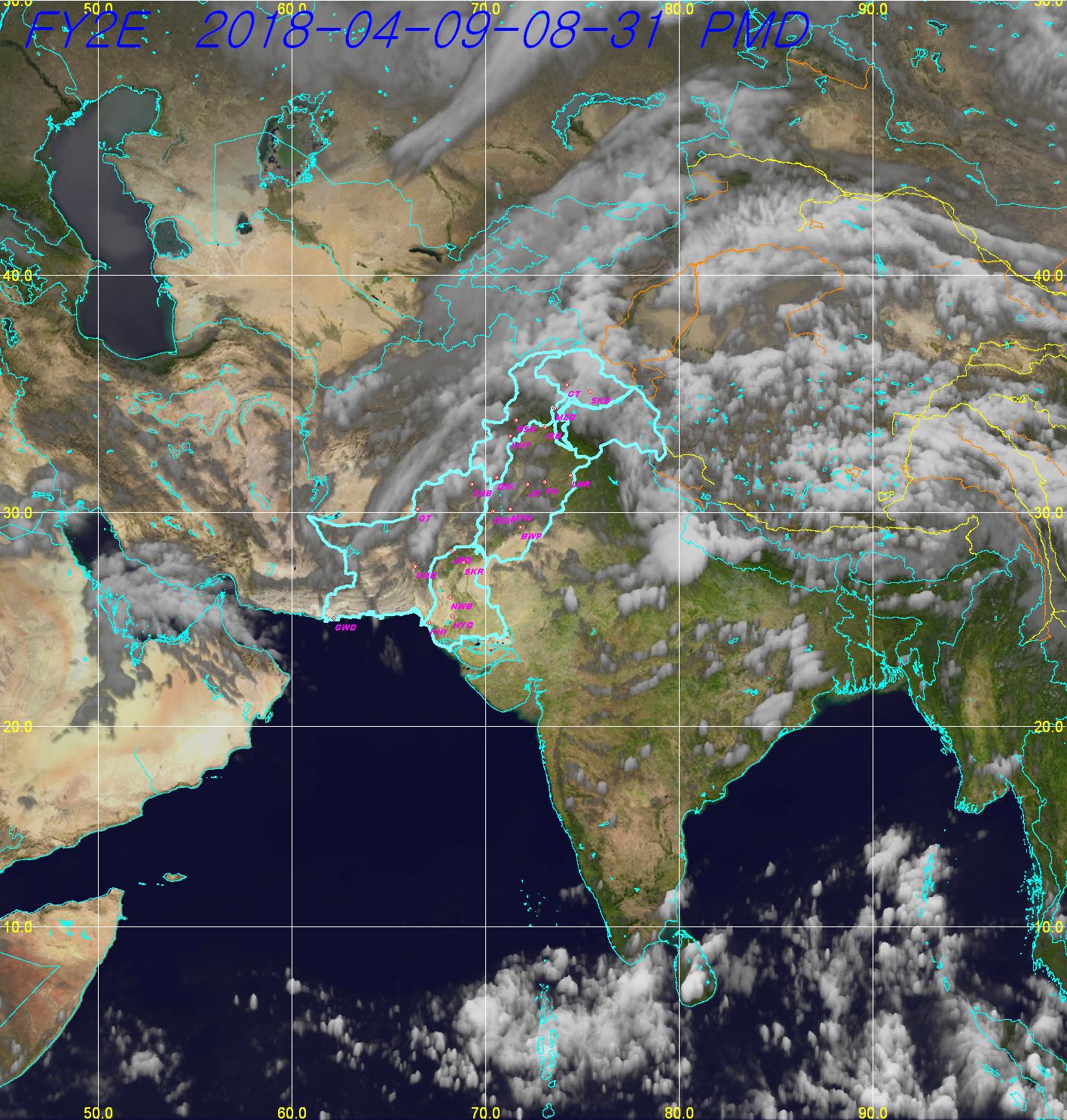


 Pakistan Weather Portal (PWP)