


Quick Summary
The article argues that extreme heatwaves in India and Pakistan are a normal seasonal feature from April to June, though climate change has increased their intensity and coverage over time. It explains that India dominating global heat rankings in 2026 was not solely due to unprecedented local heat, but also because parts of the Middle East experienced comparatively cooler conditions caused by temporary atmospheric variability. The article emphasizes that global “hottest places” rankings depend on weather patterns across multiple regions, as well as evolving temperature measurement methods and expanded weather station coverage.
Taking into account the example of the recent heatwave in India, CNN reported, “something very unusual happened…in late April…Every single one of the planet’s top 50 hottest cities was in India.”

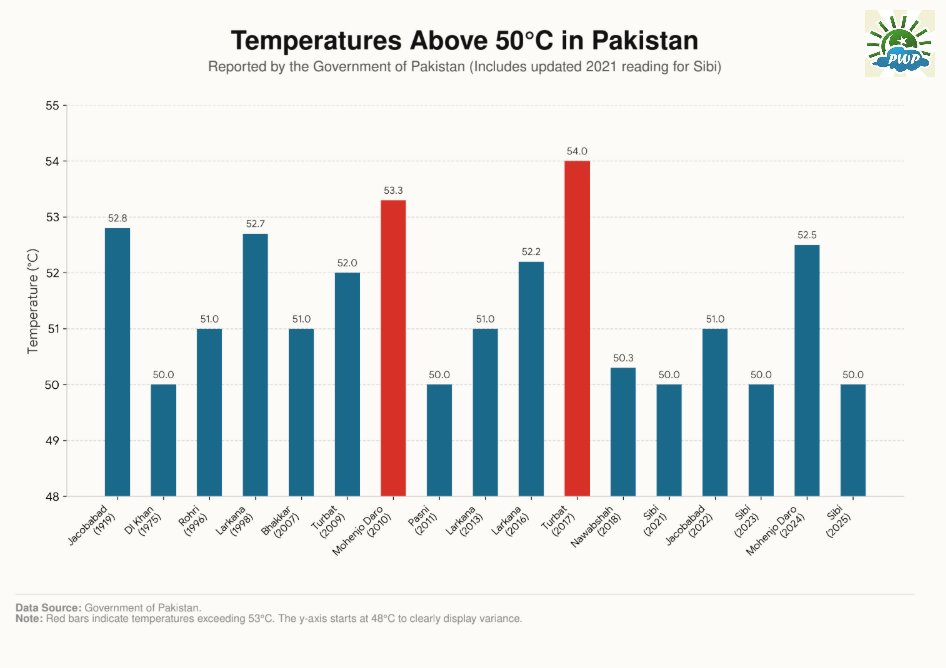
The truth is that from April to May and June, India (as well as Pakistan) experiences extremely high temperatures, with maximum daytime temperatures above 45°C in many cities and towns. The heatwave itself was not unusual, and there is highly reliable data that has been cross-checked and verified to support the claim of extreme heat conditions in the region. Extreme heatwaves are common in South Asia from March to June. Though their intensity and coverage have increased since the start of the 20th century, as we noted in the image below (2019 and 2026 also reported above 50°C temperature in Pakistan), due to climate change, as well as how the data is collected, i.e., what methodology was used to measure the temperature, and whether the number of weather stations has increased, and how those stations are distributed.
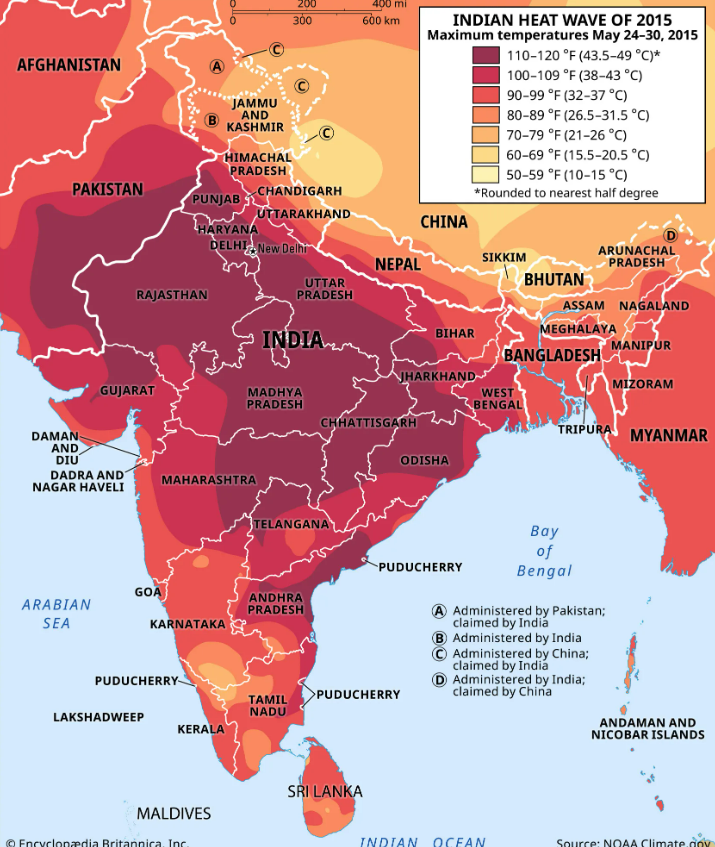
This is an important caveat because if we take the data from NOAA in 2015, one can easily note that large areas from the Indian state of Rajasthan to Odisha, an area as long as 1,610 KM, experienced a severe heatwave with temperatures in the range of 43.5°C to 49°C during the 2015 heatwave.
The counter-argument will be that these places were not the hottest cities or towns in the world as they were in 2026, and that is because, unlike in 2015, large areas of the Middle East experienced periods of reduced extreme heat due to synoptic variability associated with extratropical storms and shifting circulation patterns in March and April. The cooling effect in the Middle East was not unusual in a climatological sense and can occur in ENSO neutral conditions, bearing resemblance to variability seen in years like 2024. However, since the Middle East is typically one of the global regions that frequently records some of the highest temperatures, even a temporary reduction in extreme peaks can shift the composition of global top-end temperature rankings, meaning that the highest observed values during that period were more frequently recorded in India, where pre-monsoon heat conditions remained strongly active. This does not imply a causal relationship between regions, but rather reflects how extreme-value rankings depend on the distribution of observed temperatures across multiple hot regions.


