


Quick Summary
Pakistan Meteorological Department (PMD) projects a dry anomaly across northeastern Punjab for the June–July–August 2026 monsoon, driven by El Niño. While the Indian Meteorological Department forecasts a neutral Indian Ocean, the PMD expects a positive Indian Ocean Dipole (IOD) to develop by July, which has historically served as a “backup shield” to counter El Niño’s suppressive effects, as seen during the above-normal monsoon in 1997. Historical data from 2023 demonstrate that Lahore’s localized urban microclimate, combined with westerlies and Arabian Sea moisture, can override El Niño. Consequently, intense localized heat and moisture convergence mean that short-duration, extreme cloudbursts and urban flooding remain a distinct threat.
The Government of Pakistan (GoP) is estimating significantly below-normal monsoon rains during June–July–August (JJA), particularly focusing on the Lahore zone.
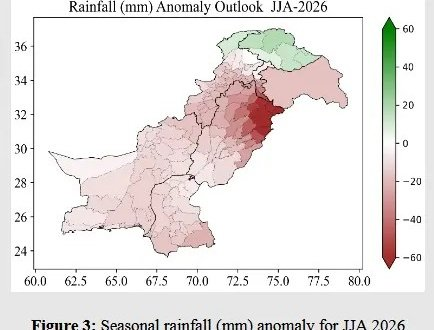
As shown in the seasonal rainfall anomaly map, the Pakistan Meteorological Department (PMD) projects a dry anomaly of -40 to -60 mm across northeastern Punjab. This forecast hinges primarily on a developing El Niño in the Pacific, a phenomenon known for shifting global wind patterns and suppressing South Asian monsoon circulation.
Comparison of 2026’s Monsoon with 2015 and 1997
The relationship between El Niño and regional rainfall is highly complex, as noted by PWP in our 2023 article. Historical precedents demonstrate that the Indian Ocean Dipole (IOD), MJO phases, presence of westerlies, and regional oscillation serve as the ultimate swing factor when a strong El Niño strikes:
- 1997: A massive El Niño emerged, but a powerful positive IOD countered it so effectively. In Pakistan, it was considered an above-normal monsoon season.
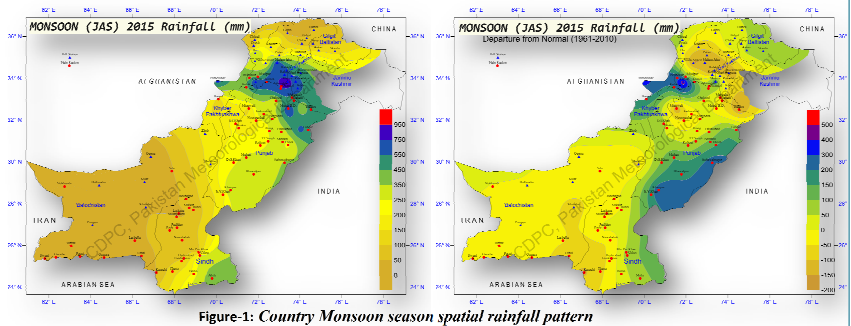
- 2015: A similar El Niño hit, though it was considered an above-normal monsoon too, with PMD stating, “The rainfall pattern of monsoon season over the country was somewhat mixed, with above normal rainfall over Punjab, KPK & GB, close to normal over Sindh & AJK, and below normal over Balochistan”.
- 2026: While the Indian Meteorological Department has forecasted that the Indian Ocean is sitting flat and neutral, leaving the region without a natural backup shield. PMD counters by forecasting a positive Indian Ocean Dipole development by July 2026.
Taking Lahore’s example of 2023 and 2024
Data compiled by PWP reveals that Lahore’s localized urban microclimate, coupled with the presence of strong westerlies and moisture incursion from the Arabian Sea, can negate the impact of El Niño.
| Date | Regional ENSO Context | Recorded Rain & Impact |
| July 2023 | Developing El Niño | A “record-breaking” 291 mm in 24 hours. |
| July 2024 | Weakening El Niño | 247 mm in 24 hours; the 3rd consecutive July crossing the 200 mm threshold. |
| August 2024 | Neutral | +350 mm (unconfirmed) storm causing urban flooding. |
Monsoon Outlook for Punjab in 2026
Even in a suppressed monsoon year, huge clusters of thunderstorms can organize over northern Pakistan due to intense localized heat and moisture convergence. Statistically, the north-eastern areas of Punjab may have an overall seasonal deficit, as argued by PMD. However, our data and historical observations from 1997 to 2024 highlight that short-duration, extreme cloudbursts remain a possibility.


