

Quick Summary
The 2026 Sindh monsoon is expected to be highly erratic and non-linear, mirroring the regional variances of 2024 and 2012. While eastern and upper Sindh face a high probability of localized heavy downpours, southern areas and Karachi are likely to see more sporadic, isolated activity due to a potential northern tilt of the monsoon trough. Despite the presence of El Niño, the season remains susceptible to extreme anomalies and hyper-local deluges, similar to the record-breaking spells and tropical activity observed in recent years.
As we approach the summer months, meteorological focus shifts towards the highly anticipated monsoon season.
The ENSO Factor: Complexities of El Niño
To understand the upcoming season, we must first look at the broader climatic drivers. As detailed in our recent analysis on the meteorological anomalies comparing the springs of 2024 and 2026, the development or weakening of the El Niño Southern Oscillation (ENSO) significantly impacts our monsoon. While a developing or established El Niño typically causes below-normal monsoon rains across Pakistan, there have always been notable exceptions (e.g., 1992 and 1997).
How the Monsoon of 2024 Unfolded in Sindh?
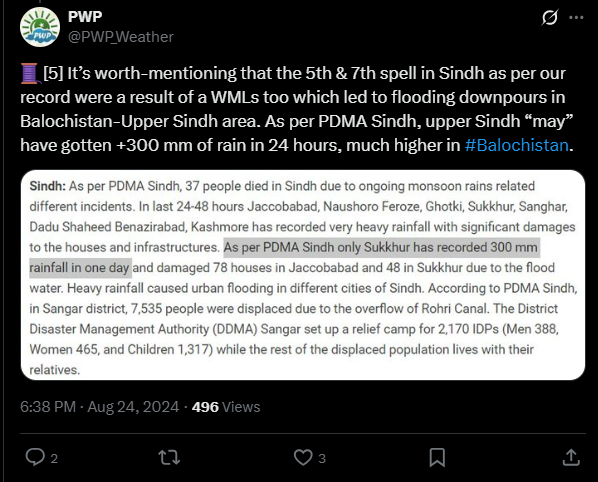
For the time being, 2024 stands as the most similar analogue year to 2026, characterized by high regional variance. As per PWP’s data, in 2024, the monsoon season in Sindh concluded with a total of 9 monsoon spells, heavily emphasizing upper Sindh. Overall, the province recorded a +109% above normal rainfall.
Breaking down the Government of Pakistan (GoP) data reveals a highly erratic temporal distribution:
June: Exceeded normal expectations with a +134% surplus, making it the 10th wettest June in 64 years. July: Saw a sharp drop, recording 44% below normal rainfall. August: The formation of the unusual Cyclone Asna, along with the 7th monsoon spell (We strongly argue that Cyclone Asna may NOT be the first August cyclone since 1976, IMD’s claim is contradicted by their own tropical storm scale and challenged by historical data) helped August rain vastly exceed expectations by +337%, marking it as the 3rd wettest August (trailing only 2022). September: Precipitation receded once again, ending 47% below normal.
Karachi saw a Below-Normal Monsoon Season in 2024
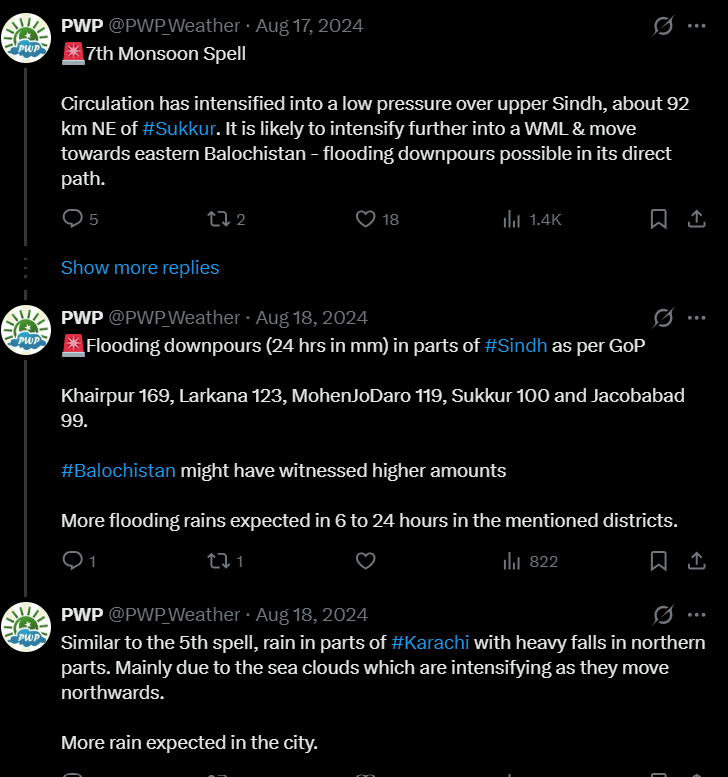
Looking specifically at Karachi during the 2024 season, the city experienced an overall below-normal season, with rainfall being 60% below normal compared to PMD’s AVG precipitation data at Jinnah Airport, updated in 2022. The monsoon was characterized by highly isolated rain activity. The 5th and 7th spells led to notable, yet strictly localized, deluges. For instance, Surjani Town recorded a heavy spell of 70 mm in 24 hours, with similar intense cloud bursts over Nazimabad during the 5th spell.
How was the Monsoon Season in Sindh, including Karachi, in 2025?
Before we finalize the 2026 outlook, we must also factor in the immediate preceding year, 2025. As per PWP’s historical records based on GoP’s data, 2025 displayed its own distinct regional variances:
June 2025: Exceeded the average monthly rain by +200% in Sindh. July 2025: The monsoon trough tilted heavily over northern Pakistan, leading to below normal July rains (32%) in Sindh. August 2025: A localized deluge in Karachi and surrounding coastal areas pushed the provincial average to a minute surplus of +1%. September 2025: Concluded the season falling between normal and above normal levels, ultimately capping off the 2025 monsoon season with above average rainfall.
Monsoon Outlook for Sindh in 2026
Taking into account the spring of 2026, the ENSO complexities, and the behavioral similarities to 2024, the upcoming 2026 monsoon in Sindh is likely to exhibit provincial variance. Drawing from the meteorological frameworks of 2024 and 2012, it is highly probable that the eastern and upper districts of Sindh can experience significant localized heavy downpours. Conversely, historical data suggests that the southern areas of Sindh, including Karachi, may encounter more sporadic precipitation patterns.


